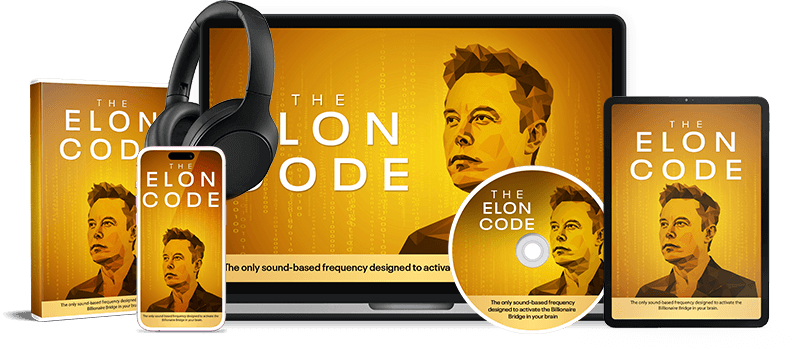
There is a cognitive tool that Elon Musk uses that most people have heard of but very few actually practice. He calls it first-principles thinking — stripping a problem to its foundational truths and reasoning upward from there, rather than from inherited assumptions.
It is the reason he could look at battery technology and see not "batteries cost X because they always have" but "batteries are made of specific materials costing Y — so the fundamental floor is Z, and everything above Z is structural inefficiency." That reasoning led to one of the most significant cost reductions in energy storage history.
The Elon Code applies this same discipline to manifestation — specifically to inherited assumptions about what is possible for you. And applied there, it is remarkably powerful.
What The Elon Code Actually Is
The Elon Code is a mindset restructuring program built around a five-step first-principles framework for identifying and dismantling inherited assumption-based limits. It is not a biography or business strategy product. It is a specific cognitive methodology applied to the belief landscape — the inherited assumptions about money, success, and your own potential — functioning as invisible ceilings.
The Five Steps Applied to Manifestation
Step 1: Identify the Inherited Assumption
Most limiting beliefs are not consciously adopted. They are inherited assumptions absorbed from your environment before you had the critical capacity to evaluate them. "People from my background do not earn that kind of money." "That level of success is for people with connections I do not have." The first step is surfacing these assumptions precisely — not vaguely, but as specific inherited frameworks.
Step 2: Trace It to Its Actual Foundation
Is this assumption grounded in fundamental reality — or in the historical patterns of a specific environment you are no longer in? Most inherited assumptions accurately described the constraints of a specific family, community, or era, and have been extrapolated incorrectly into universal laws.
The most powerful moment for most Elon Code users: tracing a specific limiting belief to its actual foundation and realising it has none. One user described it: "I traced my belief that significant income required a specific credential back to its source: one comment from my father in 1994, describing his own situation, which had nothing to do with mine. The belief had been running as a universal law for 30 years and had no actual basis." That tracing moment is where the block dissolves.
Step 3: Reason Upward from First Principles
With the inherited assumption identified and its false foundations exposed, what is actually possible? Starting from verifiable facts about your situation, capabilities, and the current state of the world — not from history, not from your family story, but from raw first-principles reality.
Step 4: Build the New Model
From first-principles reasoning, construct a new model of what is possible — not aspirational optimism but a grounded assessment. This new model is almost always significantly larger than the inherited one, because inherited models were built for a different environment and a different set of resources than the one you actually inhabit today.
Step 5: Align Action to the New Model
The new model requires new action. The program closes with a structured process for identifying first-principles-based actions — and distinguishing them from analogy-based actions (doing what others have done because it is what others have done) that typically keep intelligent people trapped in incremental results.
The Elon Code is specifically well-suited for analytical and intellectual types who find standard manifestation approaches too mystical or insufficiently rigorous. If affirmations feel like lying to yourself, if visualization feels ungrounded, if you have rejected most manifestation material as intellectually dishonest — this framework works with rigorous thinking rather than requiring you to abandon it.
"I am an engineer. Every manifestation product I have encountered required me to suspend disbelief I do not have. The Elon Code is the first framework that works with rigorous thinking rather than requiring me to abandon it."
"Step 2 — tracing the assumption to its foundation — was the most useful single exercise I have done in personal development. I found a belief I had run for 25 years and traced it to a dinner table conversation in 1998 that had nothing to do with my actual situation."
"More intellectually grounded than I expected. The first-principles application to limiting beliefs is genuinely clever and it works. Some chapters felt padded. The core methodology is strong."
"Finally — a mindset product that does not ask me to believe anything. It asks me to think more clearly. The results have been exactly what other approaches promise, through a mechanism I can actually trust."
Final Verdict: The Elon Code is uniquely valuable for analytical types who have been unable to engage with standard manifestation approaches. The first-principles methodology is genuinely powerful for dismantling inherited assumption-based limits. It requires active thinking, not passive listening. For the right person, it is exactly the framework they have been looking for. Rating: 4.0 / 5.
- First-principles framework is genuinely distinct from all others
- Strips inherited assumption-based blocks at the root
- Works especially well for analytical and logical types
- More intellectually rigorous than most mindset products
- ClickBank guarantee
- Requires active thinking work, not passive listening
- The Elon connection is more metaphor than literal method
- Not for those expecting a standard affirmation system